Introduction
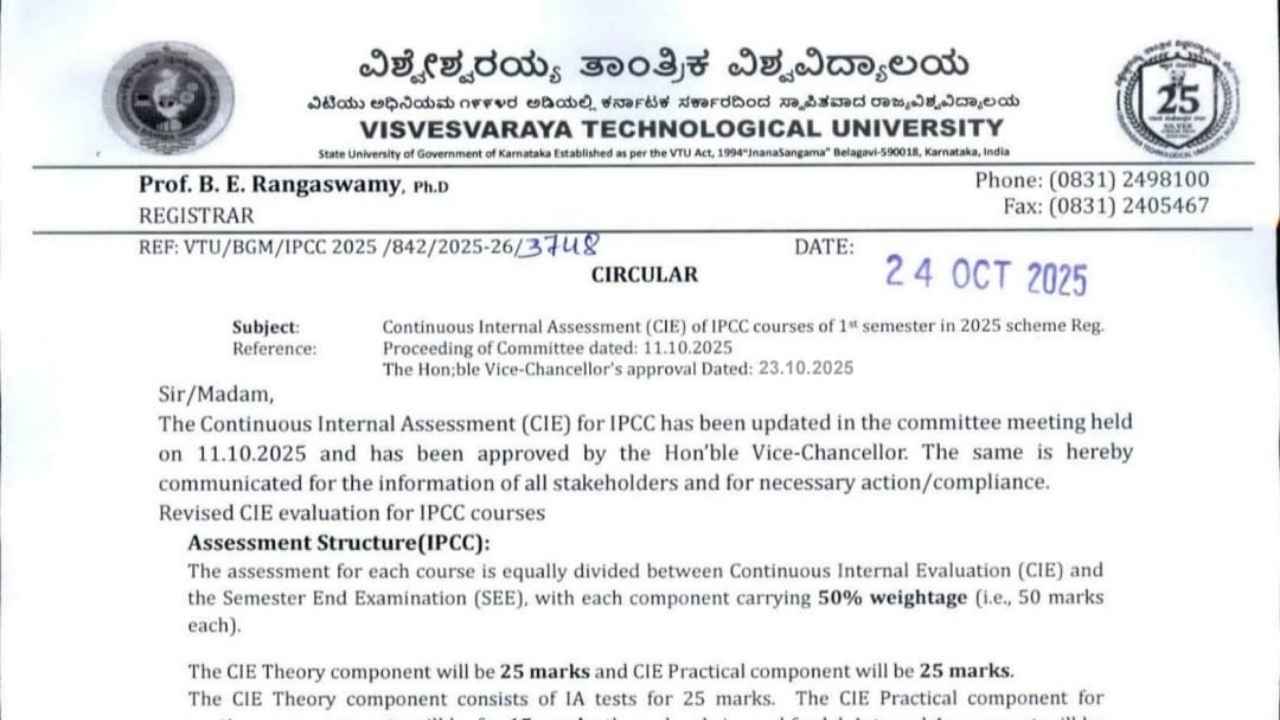
VTU IPCC CIE Assessment. The Visvesvaraya Technological University (VTU), Karnataka, has officially released a revised framework for the Continuous Internal Evaluation (CIE) of IPCC courses under the 2025 scheme. This reform marks a major step toward enhancing transparency and academic rigor in engineering education. The VTU IPCC CIE Assessment system is designed to promote continuous learning, skill development, and practical competency among students rather than focusing solely on final examination performance. This article explains the updated structure in detail, its benefits, eligibility criteria, and its impact on students and institutions.
Understanding the VTU IPCC CIE Assessment Framework

The VTU IPCC CIE Assessment divides the total evaluation of a course into two equal parts: Continuous Internal Evaluation (CIE) and Semester End Examination (SEE). Each component carries 50 marks, making the total score 100. The most notable highlight is that both theory and practical components carry equal importance, encouraging a balanced approach to learning. This structure aims to improve student engagement through regular assessments, practical performance, and continuous academic monitoring.
Breakdown of Marks in VTU IPCC CIE Assessment
Under the revised VTU IPCC CIE Assessment, the evaluation is structured as follows:
- CIE Theory Component: 25 Marks
- Consists entirely of Internal Assessment (IA) tests
- Students must score a minimum of 40% (i.e., 10 out of 25) to qualify for SEE
- CIE Practical Component: 25 Marks
- 15 marks allotted for continuous assessment using rubrics
- 10 marks allotted for laboratory Internal Assessment
- Students must secure at least 10 marks (40%) to be eligible for SEE
This balanced framework ensures that students are evaluated fairly based on continuous effort and performance, not just final exams.
Eligibility Criteria Under the VTU IPCC CIE Assessment
The eligibility rules ensure that students maintain consistent performance throughout the semester. To appear for the Semester End Examination (SEE), the following conditions must be met:
- Minimum 10 Marks in CIE Theory (out of 25)
- Minimum 10 Marks in CIE Practical (out of 25)
- Minimum 18 Marks in SEE (out of 50)
- Total Score Must Be 40 Marks or Above (combined CIE + SEE)
This system ensures that students take internal assessments seriously and actively participate throughout the semester rather than relying on last-minute preparation.
Objectives of the VTU IPCC CIE Assessment
The revised VTU IPCC CIE Assessment structure has been developed with a forward-looking vision. Its objectives include:
- Improving regular academic engagement
- Strengthening understanding through hands-on learning
- Encouraging students to focus on lab performance and practical applications
- Promoting transparency in evaluation
- Aligning VTU standards with global engineering education practices
These reforms aim to produce industry-ready graduates equipped with both theoretical knowledge and practical expertise.
Benefits of the Revised System
The revised assessment model offers numerous benefits to students and faculty alike:
1. Encourages Consistent Learning
Instead of studying only during exam time, students must stay attentive throughout the semester, promoting better academic discipline.
2. Strengthens Practical Knowledge
By allocating equal weightage to theory and labs, the system ensures students are well-prepared for industry requirements.
3. Increases Awareness and Accountability
The continuous nature of the VTU IPCC CIE Assessment helps students stay aware of their academic standings and make timely improvements.
4. Reduces Exam Stress
With 50% marks earned during the semester, the pressure on the final exam is reduced, leading to a healthier academic environment.
Role of VTU Institutions and Faculty
All affiliated colleges, principals, chairpersons, and faculty members are instructed to implement this revised structure without delay. This includes updating syllabi, conducting IA tests on schedule, and ensuring that lab rubrics are followed accurately. Regular communication with students about their scores and progress is mandatory to ensure transparency.
Impact on Student Success
The VTU IPCC CIE Assessment model directly contributes to improving student success rates. Students who perform consistently throughout the year are more likely to pass both internal and external assessments. This continuous approach not only strengthens academic performance but also builds confidence and prepares students for real-world professional challenges.
Conclusion
The VTU IPCC CIE Assessment marks a significant reform in the education system of Karnataka’s premier technical university. By equally emphasizing theory and practical evaluation, VTU ensures that engineering graduates possess a balanced skill set aligned with industry standards. This new system will undoubtedly lead to improved academic outcomes, enhanced learning experiences, and stronger student engagement.
Final Thoughts
This reform is a step toward quality education and student-centered evaluation. It is a powerful move toward transforming engineering education in Karnataka. Through the VTU IPCC CIE Assessment, VTU is not just evaluating students—it is shaping future engineers with competence, confidence, and clarity.